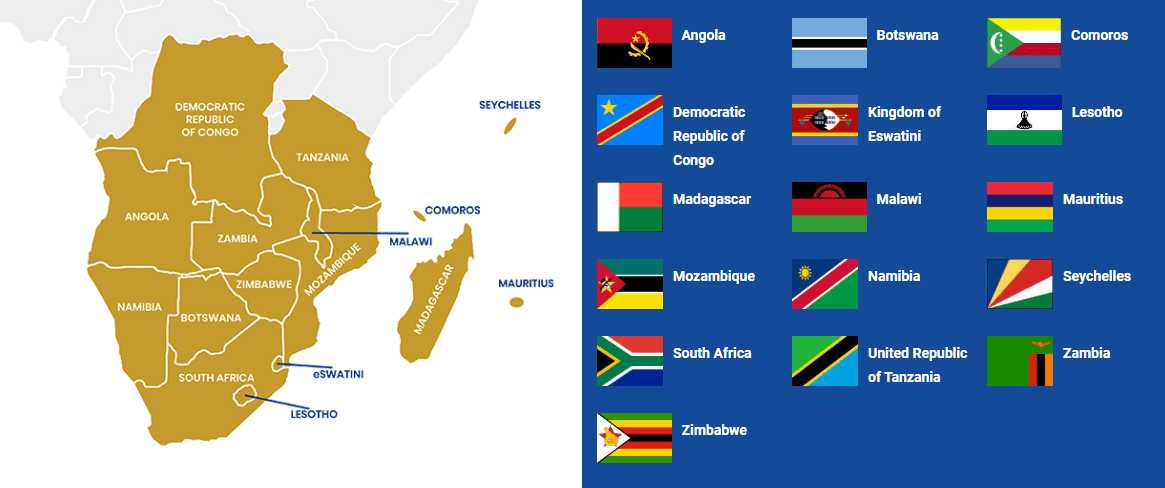
The Southern African Development Community (SADC) is a regional organization aiming to promote economic development, regional integration, peace, and security among member states. For the Democratic Republic of the Congo (DRC), joining this regional community marks a strategic turning point in external policy and economic development.
Origin and History of SADC
From SADCC to SADC and DRC accession
Origin and Evolution
SADC was established in 1980 under the initial name SADCC (Southern African Development Coordination Conference), before officially becoming SADC in 1992.
Its main objective is to promote sustainable economic development, regional integration, and political cooperation among its member states.
The DRC joined SADC in September 1997, under the presidency of Laurent-Désiré Kabila. This accession aimed to open the DRC to regional development dynamics, benefit from political support during a period of internal crisis, and strengthen economic opportunities through access to a broader regional market.
Evolution of DRC Participation
The DRC within the SADC Area
Since joining, the DRC has gradually integrated into SADC structures, although internal challenges have slowed its active participation. Nevertheless, the country has taken part in several regional programs and projects, particularly in energy, infrastructure, peace and security, and trade.
The central geographical position of the DRC in the region, bordered by nine countries, represents a major strategic asset. It allows it to serve as a bridge between Central and Southern Africa, reinforcing its role within SADC.
A National SADC Secretariat was established in Kinshasa to coordinate regional programs, foster cooperation among line ministries, and track country commitments within the SADC area.
Impacts on the Ministry of External Trade
Commercial Integration and Trade Facilitation
Harmonization of Trade Policies
Through SADC, the DRC engaged in revising and harmonizing its trade policies. The Ministry of External Trade had to adapt several regulatory frameworks to comply with regional protocols, particularly regarding trade, non-tariff barriers, and rules of origin.
Trade Facilitation and Commercial Integration
One of the most visible impacts of SADC is the promotion of free movement of goods and services. The Ministry of External Trade collaborates with customs, transportation, and finance ministries to implement trade corridors such as the Lobito Corridor or the Northern Corridor (DRC-Zambia).
Initiatives such as single-window border posts aim to facilitate cross-border trade, reduce delays, and improve the business environment.
Challenges and Opportunities
Issues Related to Regional Integration
Despite these advances, several challenges persist. The ministry faces structural difficulties: institutional weakness, lack of inter-administrative coordination, slow implementation of commitments, border corruption, and inadequate infrastructure.
All these elements hinder the effective integration of the DRC into the SADC common market.
Regional integration has also created new opportunities: the DRC benefits from access to a regional market of over 300 million consumers.
The Ministry of External Trade leverages cooperation frameworks to attract funding, build technical capacity, and promote Congolese exports across the region.
Harmonizing standards and certifications also paves the way for enhanced competitiveness of local products.
Concrete Initiatives
Key actions related to regional integration
01
DRC-Zambia Trade Facilitation
DRC-Zambia trade facilitation program with the implementation of a single-window post at Kasumbalesa border crossing to speed up cargo clearance.
02
Lobito Corridor
With support from Angola and Zambia, this project aims to connect southern DRC to the Port of Lobito, thereby improving access to export markets.
03
Regional Trade Fairs
Participation in SADC regional trade fairs and support for Congolese economic operators to promote their products in regional exhibitions.
Main areas of cooperation:
-
Trade and economic integration.
-
Cross-border trade facilitation.
-
Infrastructure and trade corridors.
-
Energy and regional development.
-
Harmonization of trade policies and frameworks.
The DRC's integration into SADC represented a major turning point in its trade and diplomatic strategy. It comes with challenges related to regulatory reforms, cooperation, infrastructure development, and opening up to the regional market.
DRC in SADC
Regional integration serving trade
The DRC's integration into SADC forms an important framework for regional cooperation. For the Ministry of External Trade, this participation involves harmonizing trade policies, facilitating trade, supporting economic operators, and promoting Congolese exports across the region.